A BSG PERSPECTIVE
Crossing the AI chasm: How Banks and Insurers are learning in production
By Emile Thiele, Associate Partner
Context:
Financial services has moved beyond AI experimentation, shifting from pilots to building real, repeatable capability. The new gap is between organisations embedding AI into how they work and those still waiting.
Success now depends on doing the hard work upfront integrating AI with systems, governing it properly, and embedding the right skills and discipline. AI is becoming a repeatable capability, rather than a one-off investment, creating advantage for those who can apply it consistently to solve meaningful business and customer problems.
In conversations with leaders across financial services, one question comes up often:
“What are other organisations doing?”
It is a reasonable question. No one wants to fall behind. We see across our clients that organisations are moving at different speeds based on two things:
1. how important they believe technology is to their future, and
2. how comfortable they are acting before the path is proven.
Some are moving early. Some are moving carefully. Some are still deciding where to begin. The gap is between organisations building the capability to apply technology well, and those still waiting to see what others do.
Regardless of position, five practical shifts are becoming clear.
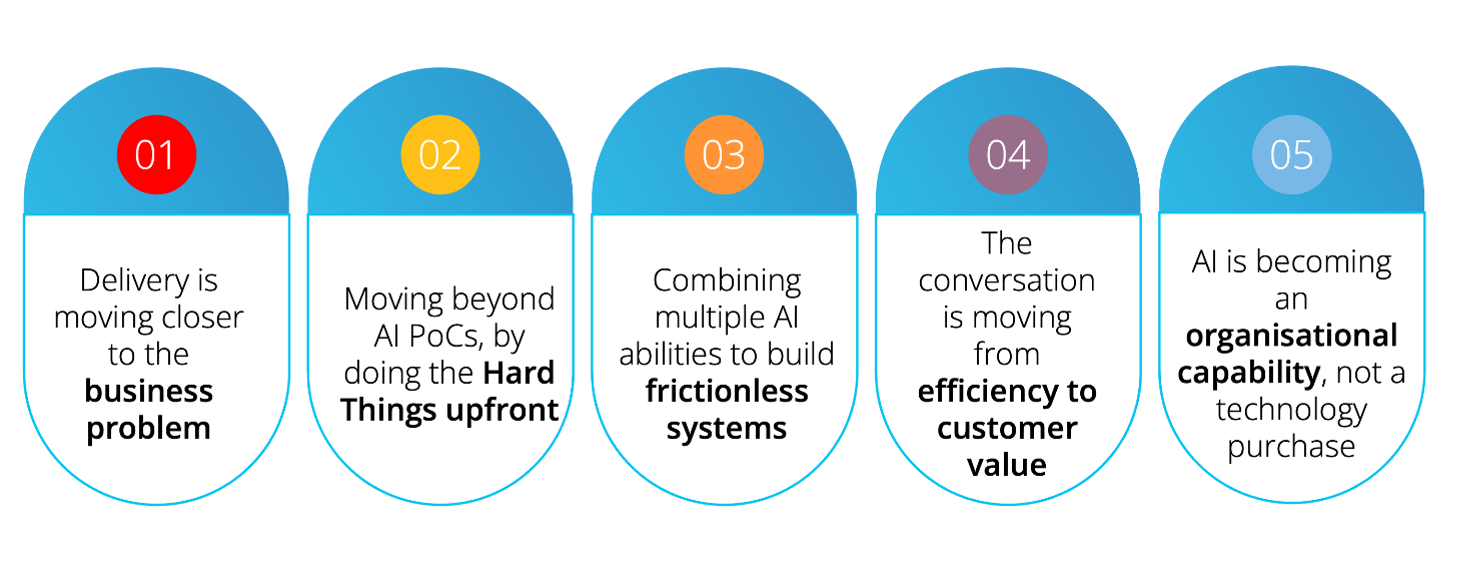
Five practical shifts
1. Delivery is moving closer to the business
For a long time, technology delivery was largely centralised. The business defined a need, handed it over, and waited for a solution. That model still has a role. Good governance, security, shared platforms and architecture remain essential. More organisations are recognising that meaningful change happens faster when the people solving a problem are close to the people experiencing it. A claims team understands claims’ friction, an underwriting team understands the decisions that slow down an application, and a distribution team knows where advisers and customers lose momentum. When those teams have better access to data, technology skills and the right tools, they can solve real problems faster and with more precision.
Central functions are changing their role increasingly to provide the foundations, standards and controls that allow domain teams to build safely and effectively. In principle the closer capability sits to the problem, the more likely it is to create useful value.
2. Moving beyond AI Proof of Concepts (PoCs), by doing the hard things upfront
Many financial services organisations have now run AI pilots. They have explored use cases, tested tools and demonstrated what may be possible. That work matters. But a proof of concept is not a business outcome. The harder questions start when an organisation wants to use AI in a live process:
- Can it work with existing systems?
- Can it be governed properly?
- Can it be trusted with sensitive data?
- Can it be monitored?
- Can teams use it consistently?
- Does it still create value once the novelty has worn off?
This is why the focus is moving from experimentation to execution. Organisations are starting to spend less time asking whether AI can do something, and more time deciding where it should be used, how it should be controlled, and what needs to be true for it to work in the real world. That shift also changes the type of support organisations need. Short projects can prove a point. Long-term value requires architecture, process redesign, risk management, operating discipline and people who understand the business context.
A year ago, AI in financial services was dominated by pilots and proof-of-concepts. The reason why most POCs fail can be summed up as, not intending to get to production from the start. The focus across most organisations we work with in the year ahead has become to put useful capability into production and learning to improve it over time. This requires doing many hard things upfront to chart the path to production and using POCs as ways of overcoming feasibility hurdles rather than “innovation theatre”.
3. Combining multiple AI to build frictionless systems
AI is rarely valuable as a stand-alone tool. Its value becomes clearer when it is connected to the systems, data and workflows and contexts that already run the business. For example, an AI model may be able to read an email, summarise a document or identify intent. But the business value only appears when that capability helps complete a real process behind the scenes, for example routing a request, retrieving the right information, supporting a decision, updating a system or helping a customer get a faster answer.
Using AI as a friction remover relies on unstructured data validation, secure integration, well-designed workflows, process context, appropriate controls and accountability. This is particularly important in financial services, where the cost of a poor decision is not limited to inconvenience. It can affect a customer’s finances, an organisation’s reputation and its regulatory obligations.
The practical opportunity is to identify where work is slow, repetitive, difficult to navigate or overly dependent on manual effort, then use the right combination of technology to improve or eliminate steps. We are reimaging processes where the AI is invisibly making never-before-seen experiences that are simple and intuitive possible.
4. The conversation is moving from efficiency to customer value
Much of the early conversation about AI focused on efficiency by reducing effort, lowering cost and automating tasks. Those benefits remain important. Financial services organisations operate at scale, and small improvements can matter greatly. There is however a broader opportunity, AI can also help organisations serve customers more clearly, more quickly and with greater relevance.
That may mean helping a customer find the right information without searching through complex documents. It may mean giving service teams better context before they respond or making products easier to understand, helping customers complete processes conversationally, or identifying where someone needs support sooner.
Financial services can be difficult for customers to navigate. The language is complicated. The processes are slow. The products are important, but not always easy to understand. Good technology makes it feel easier, clearer and more responsive for the people who rely on it, while ensuring fair, safe and quality outcomes.
5. AI is becoming an organisational capability, not a technology purchase
Perhaps the most defining trend is a mindset shift. Organisations are realising “We are going to be building with AI for the foreseeable future - we need to get good at it.” They are beginning to understand that AI is not something they can simply buy, deploy and move on from. They need to learn how to use it well.
That means building skills. It means improving data. It means creating governance that protects the organisation without preventing progress. It means choosing the right problems to solve. It means accepting that some ideas will work, some will not, and both will teach valuable lessons. It also means recognising the importance of deep business knowledge. The most useful AI applications in financial services will not come from technology in isolation. They will come from people who understand claims, lending, underwriting, advice, servicing, compliance, finance or distribution, who can apply technology to those problems responsibly.
Most will soon be able to access some of the most powerful models and capabilities ever made available, those who have learned how to use it with discipline, confidence and purpose will be more effective at achieving a return on their investment.
From “what are others are doing?” to “How do we compete?”
Across our clients we are seeing different priorities, different risk appetites and different views on how important AI and technology will be to their future. Some are learning in production. Some are still building confidence. Some are investing deeply in long-term capability.
Rather than asking “What are others doing?”, perhaps the more useful questions are:
- "What are we learning?"
- "Are we building capability where it matters?" and most importantly,
- "Are we getting better at solving the problems that matter to our customers and our business?"
Or better yet, "What is the next meaningful step our organisation can take today?"
A PROACTIVE FORCE FOR POSITIVE CHANGE
At BSG, we help you cut through complexity, mitigate costly pitfalls, and accelerate value from day one: from Strategy to Execution.
Contact us today to discover how we can help you take control of your transformation journey and finish strong.